Introduction: The Evolution of the Indian Welfare State in 2026
As of April 2026, the institutional framework of the Indian welfare state has undergone a fundamental metamorphosis. Governance has transitioned from a traditional “push” model—where the state sought out beneficiaries—to a sophisticated “pull” model powered by a unified digital marketplace. This evolution is centered on the concepts of “Digital Sovereignty” and “Ease of Living,” facilitated by the robust expansion of Digital Public Infrastructure (DPI) under Digital India 2.0.
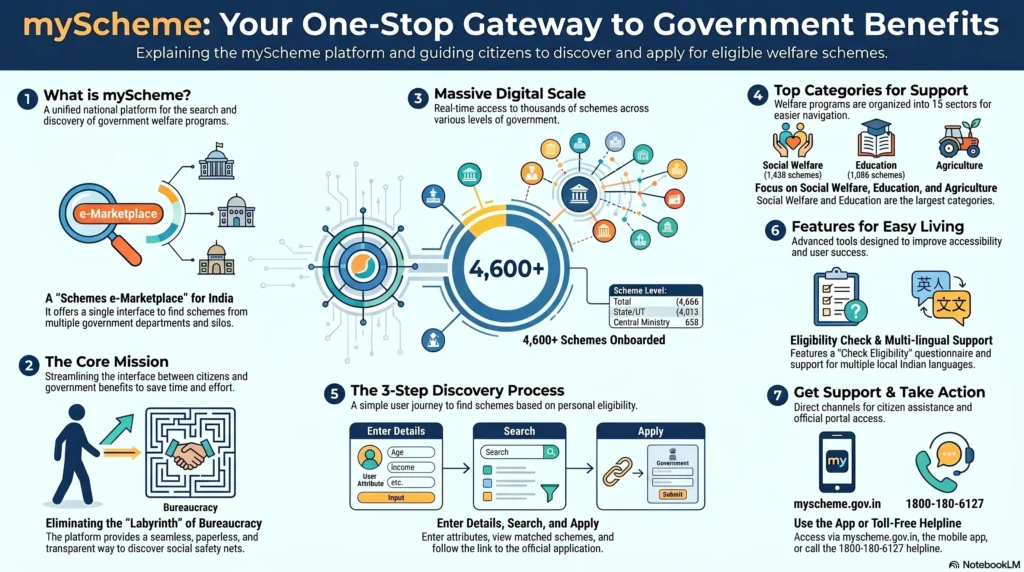
The scale of this ecosystem is unprecedented. As of late April 2026, the national repository tracks over 4,660+ government schemes, comprising more than 650+ Central schemes and over 4,010+ State and Union Territory (UT) initiatives. This guide provides a comprehensive overview of how Government Schemes 2026 are structured to drive inclusive growth, utilizing technology to ensure that the benefits of developmental policies reach the intended recipients with maximum transparency and minimal leakage. The current landscape is no longer just about survival; it is about the strategic integration of AI, biometrics, and fiscal precision to propel India toward its “Viksit Bharat” goals.
Navigating the Digital Marketplace: How myScheme Works
The cornerstone of modern welfare delivery is the myScheme portal, an innovative “e-Marketplace for Govt. schemes.” Developed by the Ministry of Electronics and Information Technology (MeitY) and the Digital India Corporation, this platform acts as a single national portal that eliminates administrative friction.
The myScheme portal acts as a single national portal for both Central and State governments, effectively preventing the detrimental information silos that historically hindered citizen access and left entitlements unclaimed.
The platform utilizes a technology-based solution to allow citizens to discover entitlements through an automated, “faceless” process. This mechanism ensures that the discovery of welfare is cashless, paperless, and transparent. By aggregating 4,660+ schemes into a single searchable interface, the portal removes the need for citizens to navigate hundreds of disparate departmental websites.
The Three-Step Discovery Process
To find relevant schemes, citizens follow a streamlined workflow on the myScheme portal:
- Enter Attributes: The user provides basic demographic details, including age, gender, income, and social category.
- Automated Search: The proprietary search engine parses thousands of schemes to identify those for which the citizen meets specific eligibility criteria.
- Select & Apply: The user reviews the benefits and required documents for each scheme and is then directed to the specific application URL to complete the process.
Health and Wellness: Ayushman Bharat and the Universal Senior Cover
Healthcare in 2026 has shifted toward universal coverage, with a strategic focus on preventing catastrophic medical expenditures that often trap families in poverty.
Ayushman Bharat Pradhan Mantri Jan Arogya Yojana (PM-JAY) Expansion
In a landmark update for the 2025-26 period, the government confirmed the universal expansion of PM-JAY. The scheme now provides health coverage to all Indian citizens aged 70 years and above, regardless of their income bracket. This update addresses the demographic challenge of an aging population by ensuring healthcare access as a fundamental right for the elderly.
Eligible seniors are issued a specialized Ayushman Vay Vandana Card. This card facilitates access to secondary and tertiary care hospitalization with an annual insurance limit of ₹5 lakh per family. This faceless and paperless system ensures that the elderly can seek treatment at any empanelled hospital across the country without financial distress.
The Digital Health Stack (ABDM)
The Ayushman Bharat Digital Mission (ABDM) has matured into a unified health ecosystem.
Ayushman Bharat Health Account (ABHA)
The ABHA acts as a unique health ID, creating a unified record system. It allows citizens to access medical history, prescriptions, and e-health services seamlessly.
Biopharma SHAKTI
Announced in the 2026 Budget with an allocation of ₹10,000 crore, this initiative targets the domestic production of advanced medicines, including biologics for cancer and diabetes, aimed at lowering long-term treatment costs for the common man.
Comparison of Key Health and Quality Initiatives
| Scheme Name | Focus Area | Key Benefits |
| Ayushman Bharat (PM-JAY) | Tertiary Care | ₹5 lakh annual insurance; covers all seniors 70+ via Ayushman Vay Vandana Card. |
| Mission Indradhanush | Immunization | Targeted vaccination for children and pregnant women. |
| ICMED | Quality Standards | Certification ensuring international safety of medical devices. |
| ABDM (ABHA) | Digital Health | Unified Health ID for accessing digital medical records and e-prescriptions. |
| Biopharma SHAKTI | Pharmaceuticals | ₹10,000 cr fund for biologics and drug-resistant cancer research. |
Agricultural Revolution: Digital Agriculture Mission & Farmer Support
Agriculture in 2026 is defined by “Precision and Protection.” Policy has shifted from generic subsidies to direct income stability and the integration of the Digital Agriculture Mission.
PM-KISAN and Income Stability
The Pradhan Mantri Kisan Samman Nidhi (PM-KISAN) continues to be the bedrock of rural income support. While the standard remains ₹6,000 per year, the 2026 Budget proposed hikes for high-productivity and distressed agricultural clusters, bringing support to ₹8,000–₹9,000 per year in selected districts. As of February 2026, the 22nd installment has been successfully processed via Direct Benefit Transfer (DBT).
The Prime Minister Dhan-Dhaanya Krishi Yojana
Introduced as part of the 2025-26 budget initiatives, this scheme targets 100 districts characterized by low productivity and poor credit parameters. It aims to support approximately 1.7 crore farmers by promoting crop diversification and the development of post-harvest storage infrastructure at the panchayat level.
Bharat-VISTAAR AI Tool
Launched in February 2026, the Bharat-VISTAAR platform represents a leap in digital agricultural advice.
- Voice Assistant “Bharati”: Farmers can dial 155261 to speak with “Bharati,” an AI assistant that provides guidance in multiple Indian languages.
- Real-time Advice: It offers data on crop selection, mandi prices, and eligibility checks for over 10 central agricultural schemes.
Agri-stack Architecture
The modernization of the sector is supported by a tripartite architecture:
- Farmers’ Registry: A database utilizing unique IDs for every farmer to streamline benefit delivery.
- Krishi Decision Support System: Integrated remote sensing and weather data for predictive analytics.
- Soil Profile Mapping: Detailed soil nutrient assessments conducted on a 1:10,000 scale to guide judicious fertilizer use.
Agricultural Modernization Framework
| Component | Function | Status (2026) |
| Agri-stack | Unified Farmers’ Registry | Operational in 22 States; Unique ID-linked. |
| PM-KUSUM | Solarizing Agriculture | Extended to cover 10 million solar pumps for de-dieselization. |
| Soil Mapping | Nutrient Assessment | 1:10,000 scale mapping completed for 100 “Dhan-Dhaanya” districts. |
| Agri Infra Fund | Post-Harvest Support | ₹2 cr interest subvention for storage and processing projects. |
Human Capital: Empowering Students and the Youth
The Ministry of Education and the Ministry of Skill Development are focused on preparing India’s youthful demographic for a globalized labor market under the National Education Policy (NEP) 2020.
NEP 2020 and PM-SHRI Schools
The PM Schools for Rising India (PM-SHRI) scheme is currently transforming over 14,500 existing schools into “exemplar” institutions. These schools serve as models for implementing NEP 2020, focusing on:
- Modern Infrastructure: Smart classrooms, digital labs, and high-quality learning materials.
- Pedagogical Shift: Moving from rote learning to cognitive, play-based, and experiential learning.
- U-DISE+ Integration: Mandatory unique identifiers for transparent monitoring of school performance.
Higher Education & Research Initiatives
Technical education has received a significant boost through the MERITE scheme (Technical Education). With a budget of ₹4,200 crore—funded in a 50:50 split between the Central Government and the World Bank—this initiative aims to empower 7.5 lakh students by harmonizing traditional knowledge with modern technical research.
PM Yuva 3.0
The PM Yuva 3.0 scheme provides a mentorship program for aspiring writers under the age of 30 in 23 languages. Selected authors receive a scholarship of ₹50,000 per month for six months to project Indian culture globally.
NPS Vatsalya
For long-term financial security, the NPS Vatsalya pension initiative allows parents to open retirement accounts for minors.
- Eligibility: While parents or guardians can be NRIs or OCIs, the child must be an Indian citizen.
- Contribution: A minimum annual contribution of ₹1,000 is required, and the account automatically transitions into a standard NPS account when the child reaches 18.
Women’s Empowerment: From Financial Aid to Entrepreneurship
Empowerment strategies in 2026 have shifted from general welfare toward targeted financial independence and asset building.
The Lakhpati Didi and Subhadra Schemes
The Lakhpati Didi initiative aims to enable women in Self-Help Groups (SHGs) to earn an annual income of at least ₹1 lakh. In February 2026, the target expansion was doubled, aiming to create 6 crore “Lakhpati Didis” by 2029. Complementing this is Odisha’s Subhadra Scheme, the largest women-centric financial aid program in India, providing direct assistance to over 1 crore women.
Financial Security for Women
- Mahila Samman Savings Certificate: Offers a fixed 7.5% interest rate for a two-year deposit of up to ₹2 lakh.
- PMMVY 2.0: Provides financial incentives for the second child, specifically if the child is a girl, promoting gender equity and institutional health.
- Pink E-Rickshaw: A Maharashtra state government subsidy for women to promote self-employment in urban transport.
- Nijut Moina (Assam): Monthly stipends to support girl child education and delay marriage.
Financial Inclusion & MSME Growth
The Micro, Small, and Medium Enterprises (MSME) sector was significantly recalibrated in the 2025-26 fiscal year to facilitate scaling and credit access.
Redefining the MSME Landscape
Revised definitions allow growing businesses to retain their benefits for longer periods, ensuring they do not lose credit priority as they expand.
Revised MSME Classification (2025-26)
| Category | Investment Limit | Turnover Limit |
| Micro | Up to ₹2.5 Crore | Up to ₹10 Crore |
| Small | Up to ₹25 Crore | Up to ₹100 Crore |
| Medium | Up to ₹125 Crore | Up to ₹500 Crore |
Credit Support Systems
- PM Mudra Yojana “Tarun Plus”: This category allows proven entrepreneurs to access collateral-free loans of up to ₹20 lakh.
- SME Growth Fund: Introduced in the Feb 2026 Budget, this ₹10,000 crore fund provides risk capital and strategic mentoring to promising MSMEs with international expansion potential.
- Startup India 2.0: Celebrated its 10-year anniversary in January 2026, focusing on deep-tech grants and manufacturing hubs.
Social Justice: Targeted Welfare for Marginalized Communities
The Department of Social Justice and Empowerment manages a portfolio of 86 schemes designed to uplift marginalized groups through integrated development.
PM-AJAY and Integrated Development
The Pradhan Mantri Anusuchit Jaati Abhyuday Yojana (PM-AJAY) was created by merging three previous initiatives: the Adarsh Gram Yojana, Special Central Assistance (SCA) to Scheduled Castes Sub Plan (SCSP), and the Babu Jagjivan Ram Chhatrawas Yojana (BJRCY). This ensures a streamlined, non-siloed approach to infrastructure development in villages with high Scheduled Caste populations.
Livelihood and Rehabilitation
- SMILE Scheme: Focuses on the comprehensive rehabilitation of persons engaged in begging across 181 cities, emphasizing skill training and social reintegration.
- Venture Capital Fund for SCs (VCF-SC): Provides concessional finance ranging from ₹10 lakh to ₹15 crore. Interest rates are set as low as 3.75% for women or Divyang (differently-abled) entrepreneurs.
Strategic Insight: Reframing Poverty Alleviation
Strategic research published in 2026 has reframed the conversation on poverty by highlighting the link between health behaviors and economic mobility.
The Economic Impact of Tobacco Cessation
A landmark 2026 study by ICMR-NICPR and TISS suggests that tobacco control is a potent poverty alleviation strategy. The findings indicate that tobacco is not just a health burden but a “poverty trap.”
“10.6% of Indian households (20.49 million) could rise to a higher economic class simply by quitting tobacco and redirecting expenditure toward nutrition, education, and healthcare.”
The poorest households currently spend approximately 6.4% of their monthly income on tobacco, compared to just 2% for the wealthiest. Redirection of this expenditure could move 17 million rural and 3.5 million urban households into a higher income bracket without requiring any new government cash transfers. This insight is being integrated into “Viksit Bharat” planning, viewing public health as a fiscal multiplier.
Fiscal Architecture: CS vs. CSS vs. State Schemes
Understanding the funding and administrative logic behind government schemes is essential for policy-conscious citizens and UPSC aspirants. This architecture is currently being reviewed under the 16th Finance Commission (2026-31).
Central Sector Schemes (CS)
These are 100% funded and implemented by the Central Government. They focus on national priorities under the Union List.
- Examples: Namami Gange, BharatNet, Biopharma SHAKTI.
Centrally Sponsored Schemes (CSS)
These programs are jointly funded by the Centre and the States. The implementation is handled by the states, with the Centre providing a fixed proportion of the capital.
- Funding Ratios: Typically 60:40 for general states. For North-Eastern and Himalayan states, the ratio is 90:10 due to higher security requirements, fiscal constraints, and geographical challenges.
- Examples: MGNREGA, National Health Mission, PM Awas Yojana.
State-Specific Schemes
These are formulated, financed, and implemented exclusively by states to address regional challenges.
- Examples: Rythu Bandhu (Telangana), Kanyashree (West Bengal), Subhadra Scheme (Odisha).
City Economic Regions (CERs)
A new urban development strategy for 2026, focusing on Tier-2 and Tier-3 city clusters. Each chosen region receives funding up to ₹5,000 crore to upgrade logistics and utilities, transforming them into specialized growth centers.
Conclusion: The Path Toward “Viksit Bharat”
The integration of artificial intelligence (Bharat-VISTAAR), sustainability (PM Surya Ghar), and granular demographic targeting through the 2026 Digital Census is shaping the future of a self-reliant India. The transition to a “pull” model of governance ensures that no citizen is left behind due to information asymmetry. By linking health cessation strategies with economic mobility, the state is creating a sustainable cycle of growth.
Final Checklist for Citizens
To ensure you are “Scheme-Ready” in 2026, maintain the following:
- Aadhaar-Bank Linking: Mandatory for Direct Benefit Transfers (DBT) under schemes like PM-KISAN.
- e-Shram Registration: Critical for gig workers to access the Social Security Fund. No renewal is required for the UAN, but mobile details should be updated regularly.
- PM Surya Ghar: Check eligibility for the subsidy (up to ₹78,000) for 300 units of free solar power.
- myScheme Discovery: Regularly visit the myScheme portal to discover new state or central initiatives based on your current demographic profile.
- ABHA ID: Create your digital health account to manage medical records and access Ayushman Vay Vandana Card benefits.